Peer Reviewer Process
Peer Review Process
Ilomata International Journal of Tax and Accounting
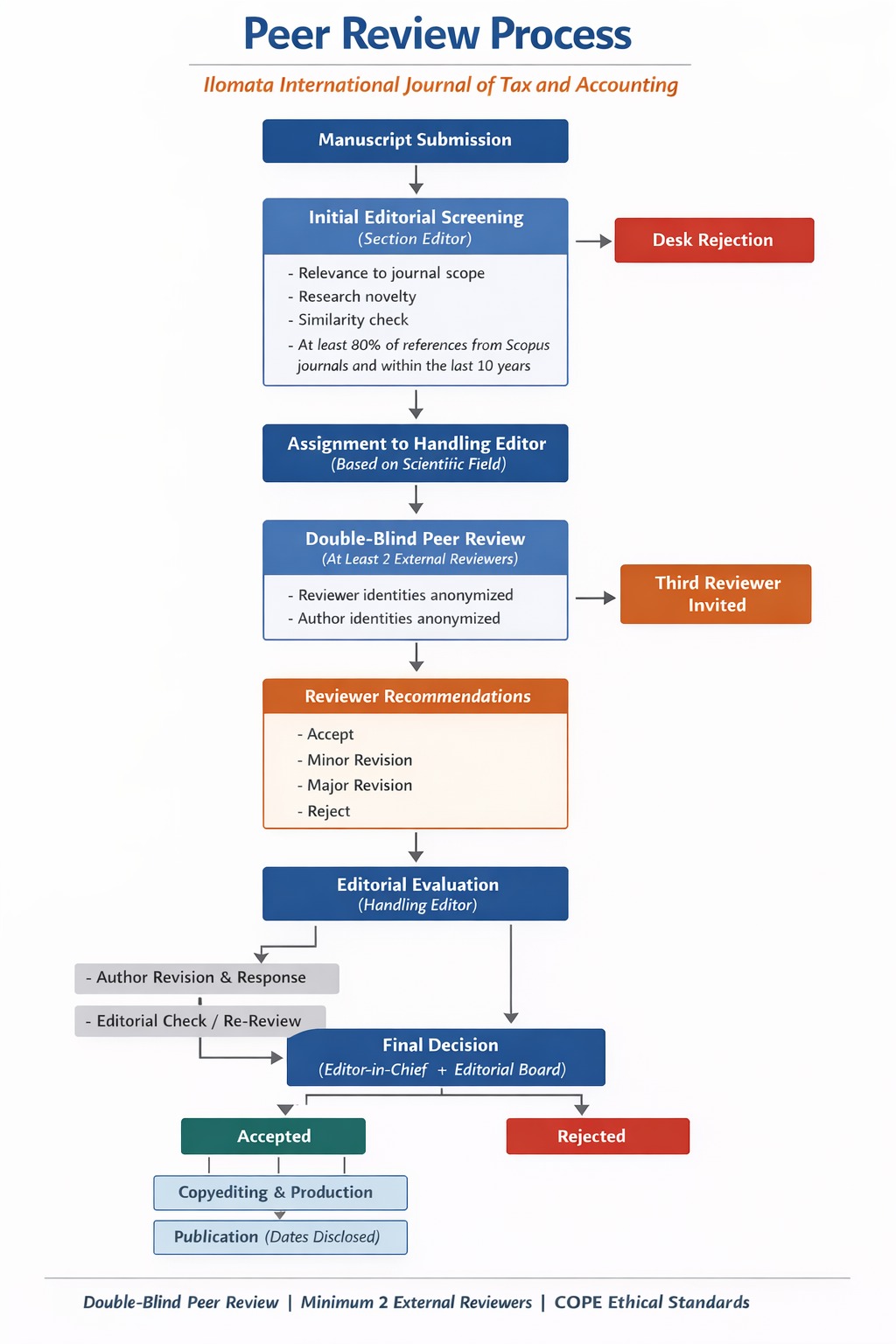
All manuscripts submitted to Ilomata International Journal of Tax and Accounting undergo a rigorous screening and review process to ensure that they fit into the journal's scope and are of sufficient academic quality and novelty to appeal to the readership of the journal. Ilomata International Journal of Tax and Accounting employs a double-blind peer-review process, in which both the author(s)' and reviewers' identities are concealed from each other.
Double-Blind Review
Author and reviewer identities are concealed from each other.
Author and reviewer identities are concealed from each other.
External Reviewers
Each manuscript is reviewed by at least two relevant experts.
Each manuscript is reviewed by at least two relevant experts.
Editorial Evaluation
Editorial decisions are based on reviewer reports and editor assessment.
Editorial decisions are based on reviewer reports and editor assessment.
Revision Cycle
Authors must respond appropriately to reviewer comments and suggestions.
Authors must respond appropriately to reviewer comments and suggestions.
1. Initial Screening by Editorial Team (Internal)
The Editor-in-Chief will screen a submitted manuscript to ensure its conformity to the scope of Ilomata International Journal of Tax and Accounting and its compliance with the basic submission requirements. The Editor-in-Chief will then assign an editor based on the article's scientific field.
2. Peer Review by External Reviewers
If the manuscript passes the initial screening stage, it will be assigned to a handling editor, who will send it to at least two experts in the relevant field to undergo a double-blind peer-review process.
Desk Rejection
Manuscripts that fail to pass the initial screening will be rejected without further review.
Manuscripts that fail to pass the initial screening will be rejected without further review.
3. First Decision: Internal and External Evaluation
A decision on a peer-reviewed manuscript will only be made upon receipt of at least two review reports. In cases where the reports differ significantly, the handling editor will invite an additional reviewer to provide a third opinion before making a decision.
ACCEPT
The manuscript may be accepted without substantial revision.
The manuscript may be accepted without substantial revision.
MINOR REVISION
Limited changes are required before further consideration.
Limited changes are required before further consideration.
MAJOR REVISION
Substantial changes are required before reassessment.
Substantial changes are required before reassessment.
REJECT
The manuscript does not meet the journal's publication standards.
The manuscript does not meet the journal's publication standards.
RESUBMISSION
Significant language or content changes require a new review cycle.
Significant language or content changes require a new review cycle.
If the manuscript is accepted, it will be returned to the submitting author for formatting. The final decision to accept the manuscript will be made by the Editor-in-Chief based on the recommendation of the handling editor and following approval by the Board of Editors.
4. Revision Stage by Internal Editor
A manuscript that requires revision will be returned to the submitting author, who will have up to three weeks to revise and format the manuscript. The revised manuscript will then be reviewed by the handling editor.
The handling editor will determine whether the changes are adequate and appropriate and whether the author(s) have sufficiently responded to the reviewers' comments and suggestions.
If the revisions are deemed inadequate, the manuscript will be returned to the submitting author for further revision. This revision cycle may be repeated until the handling editor determines that the manuscript has adequately addressed the required changes.
5. Final Decision by Internal Editor
At this stage, the revised manuscript will either be accepted or rejected. The decision depends on whether the handling editor finds that the manuscript has been improved to a level worthy of publication.
Accepted
The manuscript meets the academic and editorial standards of Ilomata International Journal of Tax and Accounting and may proceed to formatting, copyediting, and publication.
The manuscript meets the academic and editorial standards of Ilomata International Journal of Tax and Accounting and may proceed to formatting, copyediting, and publication.
Rejected
The manuscript will be rejected if the author(s) are unable to make the required changes or if the revisions remain below the journal's academic and editorial standards.
The manuscript will be rejected if the author(s) are unable to make the required changes or if the revisions remain below the journal's academic and editorial standards.
Review Workflow Timeline
1
Manuscript Submission
The manuscript is submitted through the journal's official online submission system.
The manuscript is submitted through the journal's official online submission system.
2
Initial Editorial Screening
The Editor-in-Chief checks the manuscript's scope, submission requirements, academic quality, and suitability.
The Editor-in-Chief checks the manuscript's scope, submission requirements, academic quality, and suitability.
3
Handling Editor Assignment
A handling editor is assigned according to the manuscript's scientific field.
A handling editor is assigned according to the manuscript's scientific field.
4
Double-Blind External Peer Review
The manuscript is evaluated by at least two external experts while author and reviewer identities remain concealed.
The manuscript is evaluated by at least two external experts while author and reviewer identities remain concealed.
5
Reviewer Recommendations
Reviewers recommend acceptance, minor revision, major revision, rejection, or resubmission for another review cycle.
Reviewers recommend acceptance, minor revision, major revision, rejection, or resubmission for another review cycle.
6
Author Revision
Authors are given up to three weeks to revise the manuscript and respond to reviewer comments.
Authors are given up to three weeks to revise the manuscript and respond to reviewer comments.
7
Editorial Re-Evaluation
The handling editor evaluates the revisions and the authors' responses to reviewer comments.
The handling editor evaluates the revisions and the authors' responses to reviewer comments.
8
Final Decision
The revised manuscript is accepted or rejected based on its academic quality and compliance with journal standards.
The revised manuscript is accepted or rejected based on its academic quality and compliance with journal standards.
The peer-review process of Ilomata International Journal of Tax and Accounting ensures that every published manuscript has undergone appropriate editorial screening, independent expert evaluation, author revision, and final editorial assessment. Only manuscripts that satisfy the journal's academic, ethical, and editorial standards proceed to publication.